
The Caprese Cheat Code
Stick to red, white, and green for an awesome summer sandwich

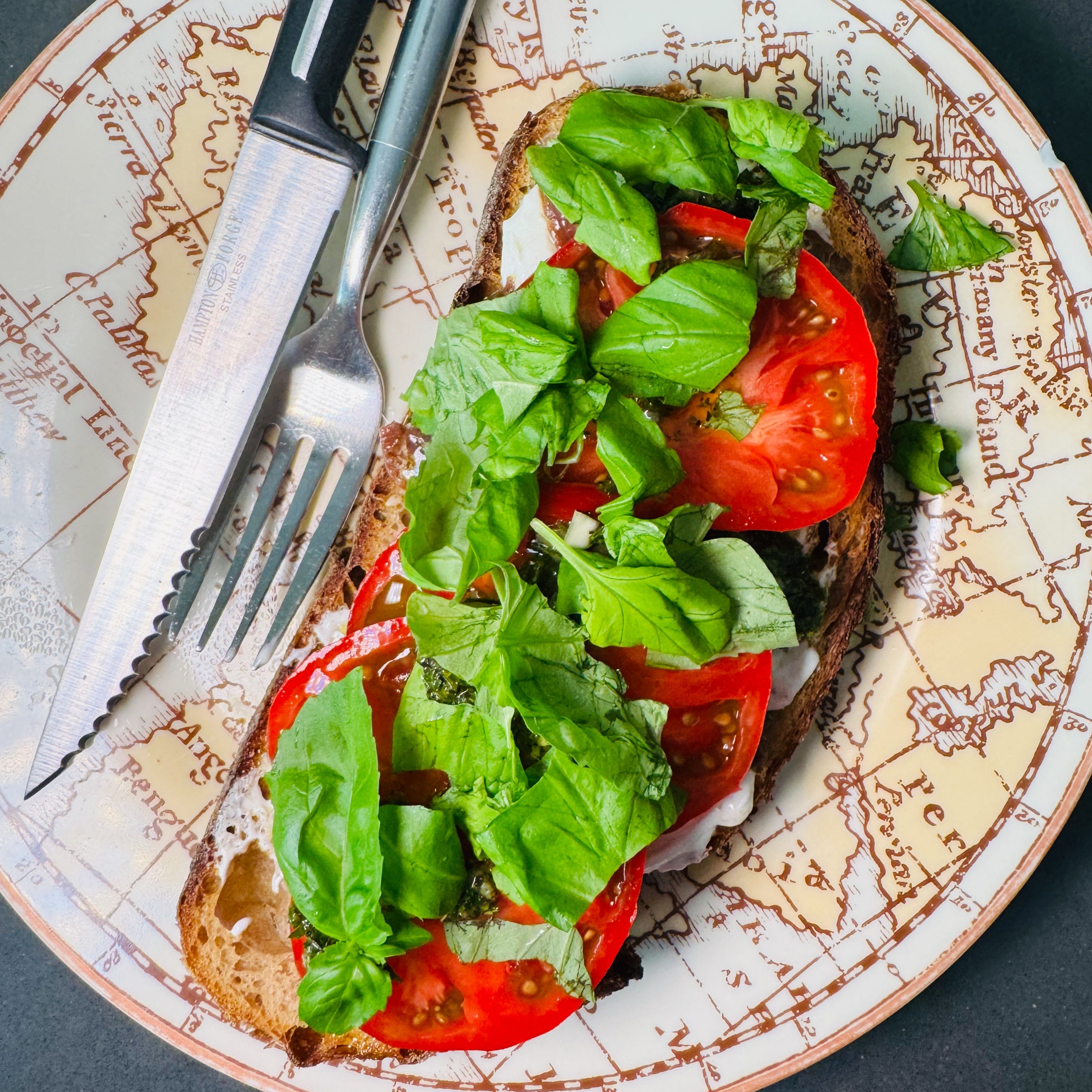
Around this time every summer I put on my invisible Nancy Meyers sun hat, traipse down to my kitchen, and make an open-faced Caprese sandwich. Part of the motivation is the abundance of seasonal ingredients; part of it is boredom; and the remainder is general pretentiousness, which I’m always excited to lean into. Truthfully though, one can only nibble away at so many turkey and cheddar sandwiches before you crave something fresh and elevated for lunch, if not slightly healthy (assuming that Caprese sandwiches are healthy, which may be debatable).
What usually gets the ball rolling is the bread. I’m fortunate enough to live near an outpost of Tartine, a San Francisco bakery known for its legendary sourdough. Every so often I treat myself to a loaf, and that kickstarts a week of me attempting all sorts of bougie (or at least aspirational) open-faced sandwiches. After all, it would be a crime to let such a fine specimen of carbohydrates go to waste.
Over the years I’ve experimented with all sorts of wannabe tartines. I’ve gone the bean route, I’ve gone the veggie route. I’ve played with fish — tinned and otherwise — and I’ve attempted cheese-forward creations. Eggs and avocado have, of course, made multiple appearances, sometimes even together, but the formula I come back to time and again is the Caprese sandwich.
The Caprese’s three central ingredients — tomato, mozzarella, and basil — are incredibly simple, and yet they produce some kind of wild vegetarian alchemy. This accounts for the sandwich’s (and the salad’s) enduring popularity. No wonder Italy’s flag bears the colors of this concoction.
But as luck would have it, whenever I actually want to make a homemade Caprese, I rarely have the raw materials to complete the task. Usually I just have bread and tomatoes. No basil. No mozzarella. What to do? Am I the victim of a highly specific lunchtime version of Murphy’s Law? And yes, I did ask AI if this qualified as a Murphy’s Law scenario. It shamed me with this response:
“Murphy’s Law specifically states: ‘If anything can go wrong, it will go wrong’—and usually at the worst possible time. It involves a specific action leading to a malfunction or an unintended, catastrophic outcome. Your situation is simply the result of poor inventory management or an incomplete grocery list.”
WELL THEN. I really can’t argue with AI on this one. Poor inventory management is an ongoing challenge in my life, but there is great news on the horizon. Turns out the almighty Caprese can easily survive some remixes, should there be a pantry shortfall. The magic formula is in the colors: red, green, and white. As long as they’re preserved, you’re going to have an excellent sandwich.
Traditionalists, now might be a good time to look away.
We start with red: tomatoes. Every Caprese does seem to need tomato. One could argue it’s the most iconic element of the legendary trio. Realistically though, a tomato might not be available. It happens! Without tomato, I might abandon the entire sandwich entirely, but in a pinch, someone could get clever and sub in roasted red peppers. This would definitely be a different Caprese, but I wouldn’t turn my nose up at it (I might quick-pickle the pepper first, just to nudge it over to tomato-ville). Similarly, pickled carrots might also be a fun, unconventional swap. You could even go as far as sliced beets - pickled or roasted. Or maybe we don’t abandon tomatoes; we just change the approach. Skip the fresh tomato and go roasted or fried. Or even crazier: sun-dried. Fun and punchy! Whichever path we go down, we want a mix of sweet and tang from this component.
For white, our options open up considerably. Instead of mozzarella, there are its siblings: burrata and stracciatella. Swirling outwards we reach provolone and ricotta and mascarpone. But there’s so much more beyond the Italian borders: feta (whipped or crumbled, Greek or French), chevre, crème fraîche! Heck, why not cream cheese? Why not cottage cheese? If you really want to go nuts, literally use nuts: cashew cheese. Or whipped tofu. Creaminess is king here.
Lastly, green. Basil is the hero, but in its place opt for its close cousin mint. Full disclosure: I think mint can be a little aggressive; so I usually skew towards dill, which always seems to work with everything anyway. If you’re really desperate, you can go the parsley route. It’s not that parsley tastes bad; it’s just not very exciting. You also don’t have to be bound by herbs. Baby spinach and arugula would be lovely vegetal additions. If red gives brightness and white gives body, green adds freshness.
So, if I spread sour cream on some bread and top it with carrots and cilantro, is that still a Caprese sandwich? Absolutely not. But it does follow the Caprese blueprint! And more importantly, it probably would be a delicious meal (unless you have that pesky gene that makes cilantro taste like soap).
Shockingly, this is not the first time I’ve felt impassioned enough to write about Caprese offshoots. Nearly two years ago I breathlessly extolled the virtues of a “Not-Quite Caprese” tartine that used air-fried cherry tomatoes and cream cheese (delicious, by the way). I also mused on some variations, some of them identical to the previous few paragraphs, which has me thinking: is this column a rerun?
No, it’s not! Because I have something new to add! I did a great spin on the Caprese formula this afternoon, and it was so good I had to immediately run over here and write this newsletter. Should the spirit of Caprese experimentation speak to you, here’s a version you might want to make (read: definitely make this).
A Very Exciting Caprese Simulation
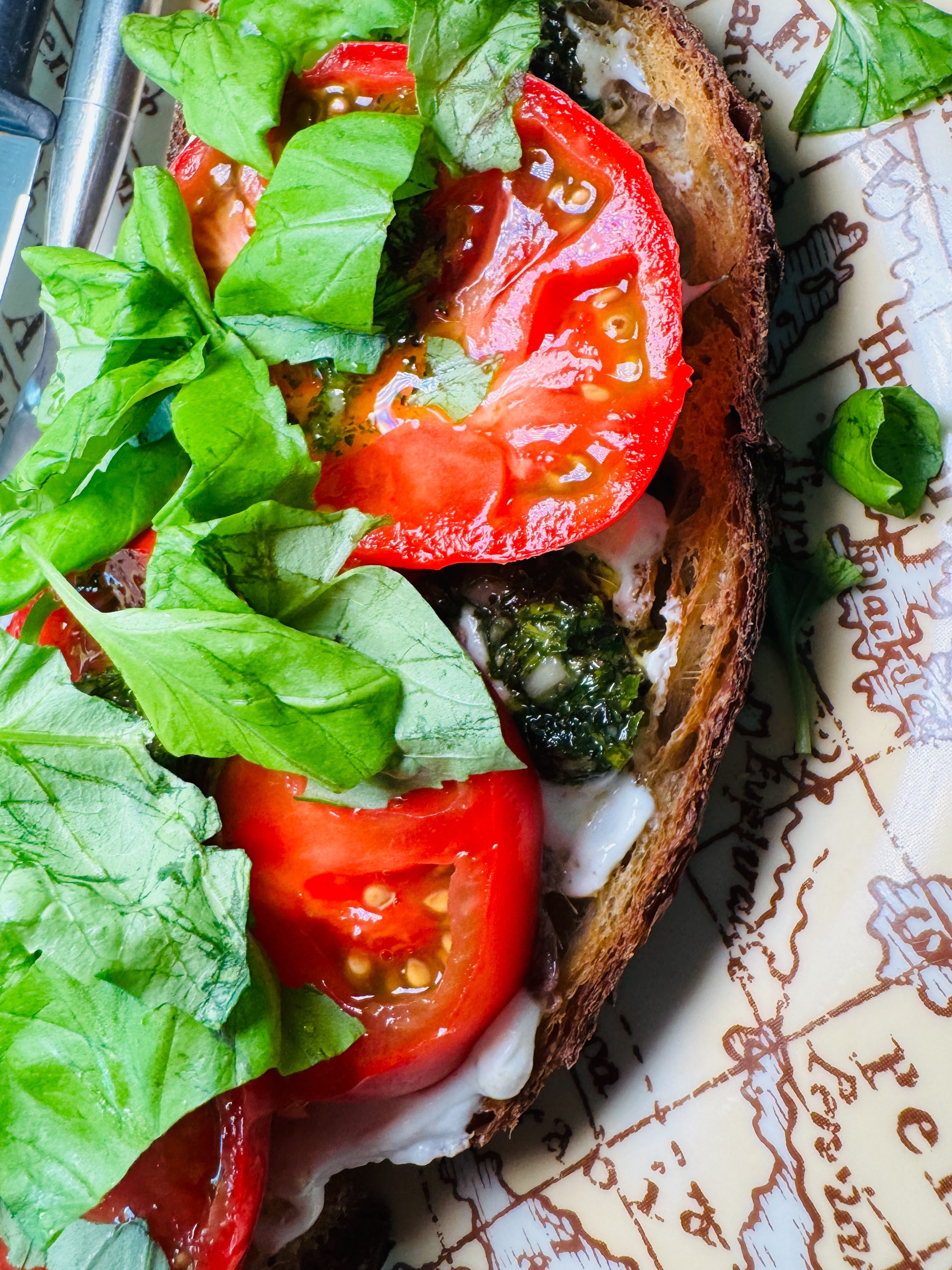
First, the bread. I toasted a slice of sourdough. Nothing fancy here - just bread in a toaster oven. I didn’t even add any olive oil to it.
When the bread emerged, I smeared a yogurt mixture atop it. This was actually leftover lemony yogurt with za’atar and dill from Colu Henry’s Spiced Lamb and Lemon Skewers, which I highly recommend cooking if you feel like living life to its fullest. However, in case you don’t want to take a grilled lamb detour, you can get away with just plain yogurt (Greek, labneh, or classic style) on this toast. A pinch of salt wouldn’t hurt.
I wanted a dash of protein on my tartine; so I draped a few anchovies across the yogurt layer. Yes, this pushes us away from Caprese territory, but I claim artistic license. Besides, the anchovies help bring out the natural umami in tomato; so I think they’ve more than earned their place in the modern Caprese conversation.
Speaking of tomatoes, I shingled a few slices over the anchovies and then drizzled with salmoriglio, an Italian condiment that employs olive oil, parsley, garlic, and oregano, among other things. It’s reminiscent of salsa verde, but with a bit more sass. We like sass. Since many Capreses have an olive oil and balsamic component, I figured the salmoriglio, leftover from a recent kitchen adventure, would sub in just fine. Chances are I won’t always have salmoriglio on hand in the future; so a simple salsa verde spiked with a dash of vinegar would probably do the trick too.
Lastly I stayed true to one aspect of a classic Caprese: the basil, which I conveniently plucked from the lopsided plant I’ve been growing for the past few months. My adorable, ungainly basil lives on my kitchen island, and I keep it alive by only watering the saucer under its pot. Incredibly, this does work. Now my basil plant has a Benson Boone mullet shape, which makes it perfect for Caprese garnish duty.

While the ingredients may suggest otherwise, this tartine was still unmistakably a Caprese, at least in spirit. It hit all the expected notes (acidic, creamy, herby) with a few others to boot, courtesy of the anchovies and salmoriglio. I’ll leave the debate over authenticity to the comments section. All that really matters is that this collection of ingredients made for a truly divine open-faced sandwich. Give it a try!
If you’re looking for a proper recipe format for the sandwich, here you go:
RECIPE: Not Quite Caprese (2026 Edition)
Ingredients:
1-2 tablespoons salmoriglio or salsa verde (optional), ingredients listed here:
1 tbs dried oregano
zest and juice of 2 lemons
2 garlic cloves, minced
1 ¼ tsp kosher salt
1/2 tsp black pepper
1/3 cup olive oil
1 slice of sourdough bread
plain yogurt, regular or Greek or labneh
salt and pepper
3-4 anchovy fillets in oil
1 medium tomato
1 small handful basil leaves
Method:
If you feel like making salmoriglio, it takes 2 seconds to whip up. Here’s the America’s Test Kitchen version: Whisk oregano, lemon zest and juice, garlic, 1¼ teaspoons salt, and ½ teaspoon pepper in bowl until salt is dissolved. Whisk in oil.
Toast your sourdough until it’s the shade you like it (medium golden is about right for me).
Add a spoonful or more of the yogurt to the toast. It should look fluffy not thin. Season lightly with kosher salt if you want. Use a fork to lift the anchovies from their oil and drape them across the bread at intervals. No need to rinse the fillets, but do shake a little of the oil off. They will be salty, but the yogurt will offset it.
Drizzle a few spoonfuls of the salmoriglio or salsa verde over the yogurt and anchovies.
Slice the tomato into 3-4 slices about 3/8 to 1/2” thick. Shingle the slices across the toast. Season with kosher salt and pepper. If you have more salmoriglio, speckle some across the tomatoes.
Give your basil leaves a rough chop or chiffonade (your choice!) and scatter liberally across the sandwich.
Enjoy!
What are some of your favorite approaches to a Caprese? Any good substitutes you’ve encountered? TELL ME EVERYTHING!
Delicious! One of my favorite sandwiches
I listen to Crappens everyday Ben and this summer have become obsessed with Caprese sandwiches. Could not love you more!